Why use goats to mange weeds?
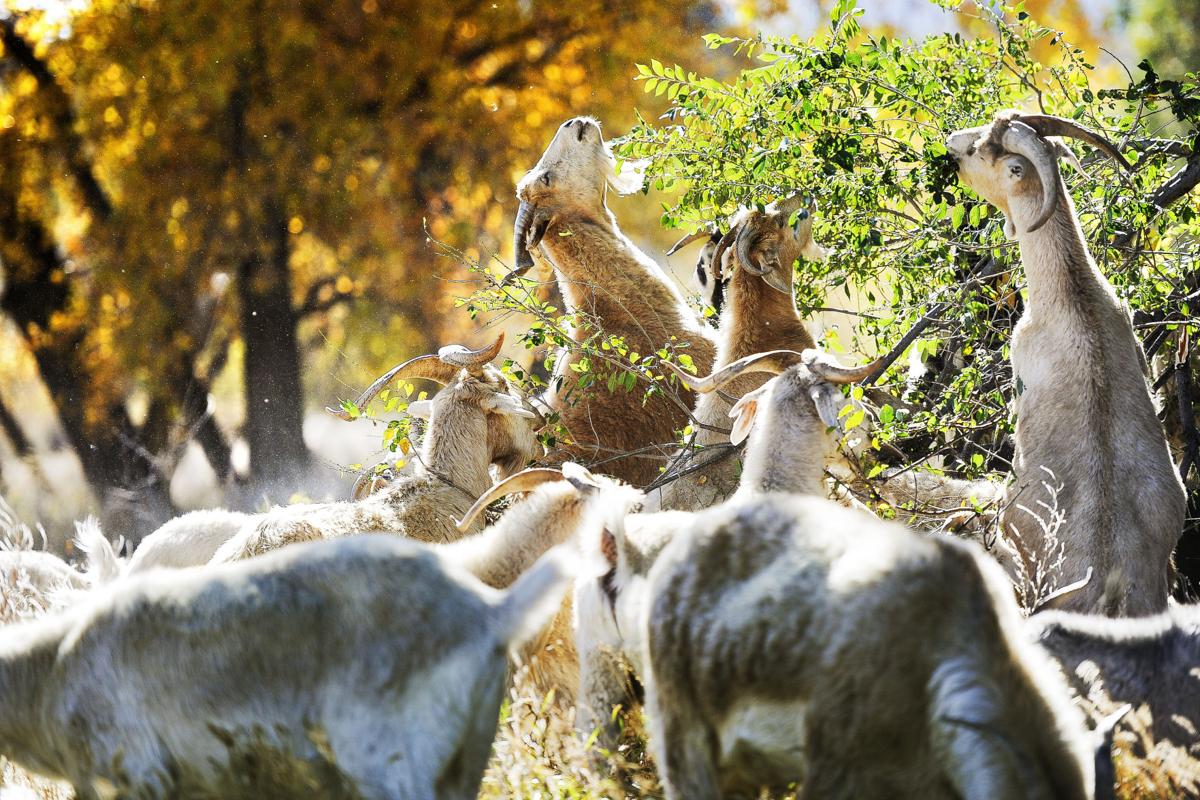
Goats are browsers—cattle and sheep are grazers. Goats prefer to eat plants that are at eye level and above, grazers prefer the natural grasses down low. By allowing the goats to browse the brush and undergrowth of invasive species, weeds, dead brush and leaves, the natural grasses can recover.
Goats will eat just about anything, but what’s their favorite food?
Weeds, like the knapweeds and yellow star thistle. Goats eat all poisonous plants, which does not seem to bother them. They also have great diet specificity by age and gender. The older males preference for what they eat first differs from the baby goats, the nannies, and yearlings. If available, the older males prefer Russian thistle and Russian olive and elm trees, while the babies’ first choice is field vine weeds. Goats are hired to eat the following weeds:
- Canada Thistle
- Cheat Grass
- Common Yansy
- Common Mullein
- Dalmatian Toad Flax
- Dandelions
- Downy Brome
- Indian Tobacco
- Knapweed
- Kudzu
- Larkspur
- Leafy Spurge
- Loco Weed
- Musk Thistle
- Oxide Daisy
- Plumeless Thistle
- Poison Hemlock
- Purple Loostrife
- Scotch Thistle
- Spotted Knapweed
- Sweet Clover
- Yellow Star Thistle
- Yucca
Do goats eat grass?
They do not like grasses; it is their last choice and they won’t eat it if there are weeds around. Goats control brush and weeds without disturbing the existing grass and soil, which make pastures in which cows graze more beneficial. The goats can be rotated in to eliminate most of the undesirable vegetation, and then the cows can come in to graze the grass without having to pick through as many weeds.
Once the goats eat the weeds, can they go to seed?
No, and here’s why. The first thing goats do when they walk through the pasture is snap off all the flower heads. Then they pick the leaves off one at a time, very quickly, leaving a bare stock. Once the goats graze the weed, it cannot go to seed because it has no flower so it cannot photosynthesize to build a root system because it doesn’t have any leaves.
It is well-documented in research that if you cut the stems off of most weeds with a sharp blade the plant will quickly respond by making just as many seeds if not more, actually making the plant denser. But because of the way a goat eats, the plant is stopped. It cannot make any seeds or photosynthesize.
What’s the problem with pesticides?
A lot of things happen when you spray pesticides. For one, the weeds can mutate and become deformed. I have seen this happen to common mullein. On my master’s research plots in Wyoming there are dead trees as a result of Tordon being sprayed ten years ago. The spraying also made a pure mono culture of Russian snapweed across the valley. The plot was then sprayed with a chemical to kill the Russian knapweed and reseeded with grasses. Every time a chemical was used to kill the Russian knapweed, white top, another noxious weed, began to grow there. For some noxious weeds, chemical sprays are ineffective. One example is oxide daisy, which has no leaf surface for the chemical to be absorbed. But, goats love it.
Do goats eat Christmas trees?
Yes, they love them. A great way for communities to recycle Christmas trees is to have people pay a nominal fee to have goats recycle them. Any money generated could then be used for weed control in that community the following summer. The goats love Christmas trees, they clean it up, strip all the bark off. The remaining tree trunk could be sold to a youth group, to be cut, packaged and sold as firewood. So the recycling keeps going on and on through all levels insects, birds, people and different groups of people.
How do you manage so many goats?
When you are managing a 1,000 head of goats, you have to be able to handle them. We manage the goats by herding them within electric fences. Once the goats accept the fence as its boundary, it is magical stuff. Guard dogs are also key to a successful operation. Our dogs protect the goats from predators, such as coyotes and feral dogs.